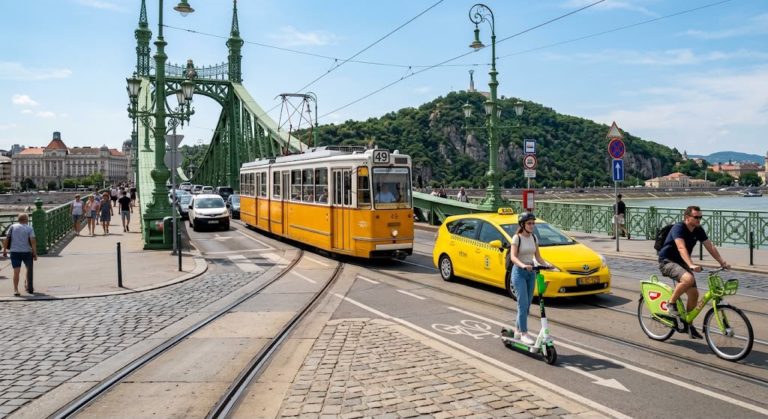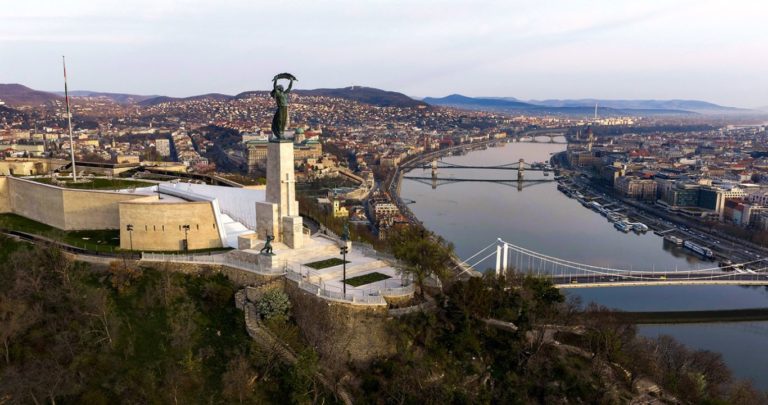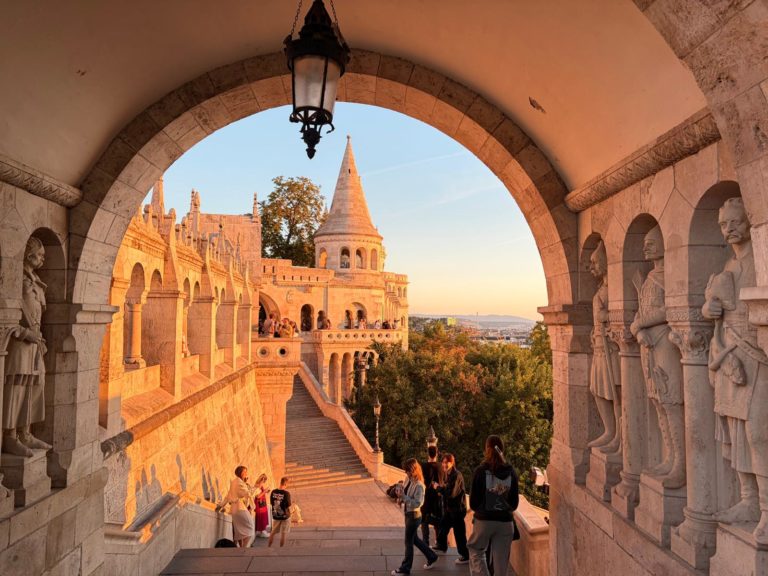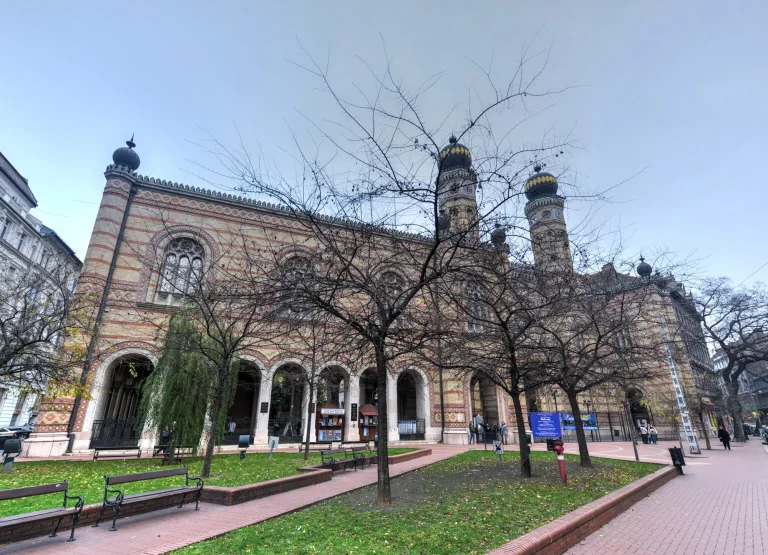
Straddling the Danube River, Budapest sits divided between Buda’s historic slopes and Pest’s flat, wide streets. The city rocks a solid public transportation system, but now e-scooters have made a huge mark too. People use them all the time for that final leg of the journey. These little scooters pop up everywhere in Hungary’s capital. Want to shoot down József körút? Hop on an e-scooter. Need to get to that uni class quick? Easy, grab one. Late night out headed to a ruin bar? Yep, you guessed it, just jump on an e-scooter. For us ride lovers, there’s tons to know about riding safely and right. That means checking out which companies operate in Budapest, what they charge, and big rules like local laws and where to park. All to make your roll around town nice and smooth. Budapest’s Primary E-Scooter Providers Unlike some European capitals that feature a chaotic…
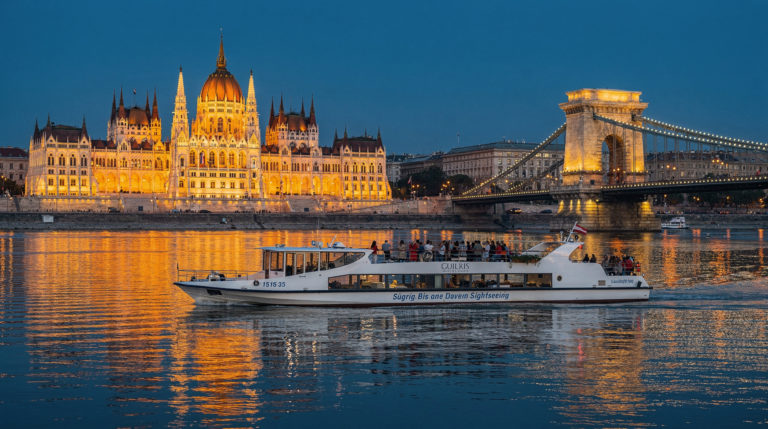
Walking along the Danube River, you can’t help but notice the most striking part of Budapest’s skyline: the Széchenyi Chain Bridge. With its amazing feat of engineering and two sturdy ends in Buda and Pest, it’s more than just a bridge—it represents Hungarian pride and unity. Now, underneath its fancy look and hefty chains is a popular tale locals adore. This story is about a nearly flawless design, a big embarrassment, and someone taking a tragic jump off the bridge into the icy water. People love sharing this intriguing mix of despair and mystery that sits alongside its glorious architecture. Why the Bridge Was Built The Chain Bridge’s size makes sense once you know about Buda and Pest before its construction. From 1849 on, these two cities were connected by the new bridge. Before that, during summertime, folks could use a floatable bridge to get across the Danube. Yet in…
When walking through Budapest’s City Park (Városliget), just a stone’s throw from the grand monuments of Heroes’ Square, you suddenly stumble upon a sweeping architectural wonderland rising from the water. With its mix of sharp gothic spires, heavy Romanesque arches, and elegant pastel walls, the complex looks like a historic royal citadel that has guarded the city for centuries. This spectacular site is Vajdahunyad Castle (Vajdahunyad vára), a place where multiple eras of European history collide in a single courtyard. But the true story behind this fairytale fortress is one of the most bizarre, fascinating, and beloved pieces of urban lore in Central Europe. It is a massive monument that was never meant to last, built by an architect who essentially created a giant piece of historical copy-pasting. The 1000-Year Celebration: A Castle Made of Cardboard The story begins in 1896, a monumental year for Hungary. The country was celebrating…
In Budapest’s City Park, right near the big Széchenyi Thermal Bath, there’s a spot that’s both mysterious and captivating. When you first look at the bronze statue, it can give you a small shiver. It shows a lone monk cloaked in a hood that fully hides his face. This is the Anonymous Statue, honoring an incredibly significant but totally unknown person in Hungarian history. Even if you don’t care much for history or are just a myth enthusiast, or if you’re wandering around Vajdahunyad Castle, you shouldn’t miss this odd statue. Who Was “Anonymus”? To understand the statue, you kinda have to begin with the man behind it, or really with the strange fog around him. “Anonymus” wasn’t only some bedtime tale, it actually existed , but almost nobody keeps the real name in mind anymore. He served as a notary and as a chronicler for a Hungarian king, a…
As soon as you start living in Budapest, after leaving Italy, you will experience a culture shock. The exact moment when you will realize you are no longer in Italy occurs when you find yourself standing in front of a Hungarian supermarket, staring at an entire shelf filled with sour cream (tejföl ) and paprika, looking for some good quality extra virgin olive oil or a piece of Parmigiano. Eating like an Italian in Budapest can become quite challenging, considering the lack of necessary ingredients, the presence of alternative local products which may seem to commit culinary high treason and the high prices charged by imported products, which may question your life choice. However, this guide will help you survive and even prosper. These are the secrets of where to purchase products, what to use instead and how to eat like an Italian in Budapest, regardless of the price. What…
When such a great city as Budapest got intertwined with the greatest football championship on the European continent, the whole city experienced radical changes. Instead of being a place where a simple ninety-minute football match was played in the stadium, the whole urban landscape had been changed into a space saturated with the love of the game. In small provincial cities, one only plays the game at local pubs and small stadiums, but when it comes to Budapest and the Champions League, then football becomes dominant not only in the stadiums, but also on squares, streets, and even on Danube islands. Budapest is full of fans of the Champions League from all over the world, who are absolutely crazy about their favorite sport and who make each corner of Budapest vibrant thanks to their energy and enthusiasm. All this happened because of the exceptional infrastructure connecting football lovers from all…
When you move from a tight-knit Italian town like Jesi to a sweeping European capital like Budapest, the shift in lifestyle hits you fast. But it’s not just the language or the architecture that changes your daily routine—it’s how you move. In Jesi, the private car is the most used way of transport; without a steering wheel, you are practically stranded. In Budapest, however, owning a car is almost an inconvenience. Here, the city doesn’t belong to the automobile, but to an interconnected web of punctual trams and buses that seamlessly tie the metropolis together. The Scale of Infrastructure: Why Size Dictates the Strategy The root of this massive divergence in transportation habits comes down to the sheer geographic and demographic scale of each location.Jesi is a compact historical town in Italy’s Marche region, that has roughly 40,000 inhabitants. Because the distance from the medieval historic centre to the newer…
Budapest isn’t crowned the “City of Baths” simply because it boasts over 100 natural springs. Beneath the rising steam and grand architectural domes lies a millennia-old narrative, stretching from the Roman legions of Aquincum, to the beautiful Ottoman baths The Roman Foundations: Aquincum and the Birth of Bath Culture The history of the Budapest thermal baths dates back almost 2,000 years to the times of Rome. When the Roman Empire founded the town of Aquincum in what today is known as Óbuda (Part of Budapest), their selection of the site was primarily influenced by its rich sources of geothermal springs on the Danube fault line. For the ancient Romans, taking baths was an essential part of their routine, cleaning habits, and recovery after wars. Numerous archaeological digs have revealed a total of 14 different baths in this region. The biggest one, called the Thermae Maiores, was a huge military bathhouse…
Just a few kilometers from the center of Budapest, away from the crowds of classic tourist routes, lies a surprising and still little-known spot: Római-part. This charming stretch of Danube riverbank offers nature, sports, gastronomy, and even a city beach. Located in the 3rd district, this area has been a favorite summer relaxation spot for the capital’s residents for decades. A Roman Name, a Roman Legacy The name “Római-part” literally means “Roman Riverside”, and for good reason. The area is located near the ruins of Aquincum, the Roman city that served as the capital of Pannonia Inferior around the 2nd century AD. Originally a military camp, Aquincum grew into a vibrant settlement of over 30,000 people, complete with amphitheaters, thermal baths, temples, aqueducts, and paved roads. Today, visitors can explore its impressive remains at the Aquincum Museum and Archaeological Park, just minutes from Római-part — a must-see for anyone interested…
The Millennium Underground line, known in Hungarian as ‘Kisföldalatti’ (literally ‘the little underground’), represents a major milestone in the history of urban transport not only in Hungary, but in Europe as a whole. Inaugurated on 2 May 1896, in commemoration of the 1,000th anniversary of the arrival of the Magyars in the Carpathian Basin, this line became the first electric metro on the European continent, surpassing similar systems in cities such as Paris (1900) and Berlin (1902).Built in record time and with a clear forward-looking vision, the Millennium Underground was not only a technical achievement, but also a statement of modernity by Budapest, which at the time was part of the burgeoning Austro-Hungarian Empire. The line was designed to improve the connection between the city centre and the City Park (Városliget), facilitating access to the millennium celebrations and the exhibition grounds.Unlike later subways, this line was built just below Andrássy…