Category

Art

Category

Should you be wandering through one of Budapest’s most bustling intersections, Blaha Lujza Square, surrounded by the rush of people, trams, and ugly concrete buildings, it can be rather difficult to concentrate on anything but all the chaos surrounding you. However, once you notice the strange dark stones protruding from the pavement, forming some sort of monument blocks, you will soon realize that there is more than just street art here. In fact, these stones are a monument erected in memory of the tragic destruction of the Old National Theatre. The Golden Age of the People’s Theater Our tale starts in the year 1875 when an opulent eclecticism-style building opened its doors here, called the Népszínház, otherwise the People’s Theater. An immense and magnificent building, adorned with an elaborate facade, arches, and spectacular halls that could accommodate thousands of enthusiastic visitors. In 1908, the building became home to the Hungarian…

When you feel the need to find some inner peace amid the bustling streets of Budapest, but at the same time do not want to leave the urban environment, then one secluded place is sure to give you just what you are looking for. This quiet spot located in the northern part of the Margaret Island is called the Japanese Garden, which, in its native language, means Japánkert. This is more than just an area with Asian flora; this is an artistically crafted living masterpiece that can be traced back to the end of the 19th century. The Vision of a Master Gardener The garden was founded in 1882, and its creation was inspired by the vision of György Magyar, who was at that time the main gardener at the royal estates located on the island. In the last decades of the nineteenth century, there occurred the craze for all…

If you have come across pictures of Budapest, chances are that you must have seen Fisherman’s Bastion at least once. Its beautiful white stonework, conical towers, and magnificent view over the Danube river make it look like something out of a fairy tale. However, it’s much more than just a scenic site; this place is a real gem of Hungarian architecture and history. This article covers all there is to know about one of the most enchanting places of Budapest, from construction through to how to enjoy it without the crowd. Who Built It (And What’s With the Name?) Despite looking like an ancient medieval fortress, Fisherman’s Bastion (Halászbástya) is surprisingly modern. It was built between 1895 and 1902 by architect Frigyes Schulek. His goal wasn’t to build a defensive fort, but rather a panoramic viewing terrace that would complement the stunning Matthias Church right next to it. It was…

As one explores Budapest, chances are one will come across the Buda Castle located on the opposite side of the river, a massive and majestic building standing high on the Castle Hill. However, here comes one interesting fact that many travelers have not realized before: the best use of time spent within these ancient castle grounds cannot be in searching for any rooms of royalty. The best thing to do in the castle is to explore the Hungarian National Gallery (Magyar Nemzeti Galéria), which is located within the wings of the royal castle. Why Visit? (Hint: It’s Not a Typical “Palace” Tour) Setting the right expectations from the beginning, the castle will not offer you any gilded halls decorated with magnificent furniture belonging to the Habsburg family. The reason being that most of the castle’s decor was destroyed in the war. Therefore, instead of royal rooms, you are presented with…

Visiting Budapest during winter time can take you to only one magical spot in this enchanting city. Lying right behind Heroes’ Square, you will find the City Park Ice Skating Rink (Városligeti Műjégpálya). What makes this particular ice skating rink more special than any other is its sheer size and location, making it seem like it was straight out of a fairy tale. The castle-like Vajdahunyad Castle, combined with the neo-Baroque pavilion, makes this particular place even more enchanting for those looking for an adventure that you cannot find in any other European country. A Playground for the High Society of the Late Nineteenth Century What makes the history of this ice rink unique is that it dates back even further than most people would think, thus making this an old, large-scale artificial ice rink facility in North America. The first records date from 1869, when a local skating club…

When you step into Heroes’ Square, the sheer scale of the Millennium Monument hits you immediately. It is a massive open space dominated by a soaring 36-meter column topped by the Archangel Gabriel and backed by two giant, semi-circular stone colonnades. Most tourists snap a quick selfie in front of the tribal Magyar chieftains on horseback and move right on, but if you look up, specifically at the very tops of those curved stone colonnades, you will spot something far more dramatic. Standing like epic sentinels at the inner edges of the columns are two massive bronze chariots driven by allegorical figures. On the left, a muscular man drives a war chariot, cracking a whip made of snakes, while on the right, a serene woman rides a chariot of peace, holding a palm branch high in the air. This intentional clash between War and Peace isn’t just decorative; it is…

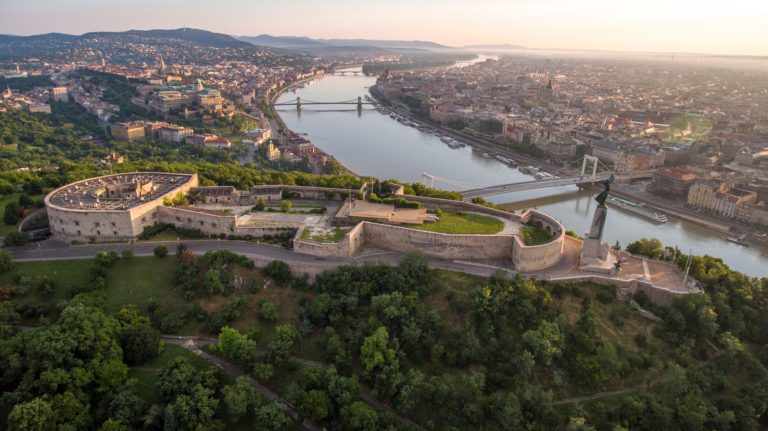
The Danube is the second largest river in the world, it doesn’t just pass through the city; it defines it. It acts as a massive, liquid mirror reflecting centuries of architectural genius, while physically separating the rolling hills of Buda from the flat, pulsing urban sprawl of Pest.But the Danube is far more than a scenic backdrop for a sunset cruise. It is a historic highway, a former militarized border, and the setting for some of the city’s most dramatic and heartbreaking moments. To truly understand Budapest, you have to understand its river and know exactly where to go to catch its most unforgettable views. A Brief History: From Roman Frontier to Golden Age Elegance The Danube (Duna in Hungarian) has been shaping the destiny of this region for thousands of years. Long before Budapest became a unified metropolis, the river served as the Limes; the fortified northern frontier of…

Imagine wandering through the dense, leafy trails of Budapest’s City Park (Városliget) and suddenly stumbling upon what looks like a giant, golden mushroom floating among the trees. This is the House of Music Hungary (Magyar Zene Háza). Since opening its doors in early 2022, this spectacular, undulating structure has completely redefined the city’s architectural landscape. It doesn’t just house music, the building itself is designed to feel like a visual symphony, thanks to his beautiful structure. Here is everything you need to know about how this beautiful structure was conceptualized, engineered, and what awaits you inside. The Vision and History For decades, the plot of land where the House of Music now sits was a dead zone, occupied by a cluster of abandoned, dilapidated Hungexpo office buildings. In 2014, as part of the massive Liget Budapest Project (the same initiative that built the nearby Museum of Ethnography), the city launched…

If you are standing on the Pest side of the city and look across the Danube River toward the rocky cliffs of Gellért Hill, there is a tiny detail that is incredibly easy to miss: a small stone portal carved directly into the mountainside, topped by a simple steel cross. From a distance, it looks like nothing more than a scenic lookout point. But if you cross the Liberty Bridge and step inside that cave mouth, you’ll find yourself in one of the most unique, spiritual, and historically dramatic spots in all of Budapest: The Cave Church (Sziklatemplom). The wild thing about this place is that you won’t find the usual polished marble pillars or soaring gothic arches here. The walls are made of raw, dark, unpolished mountain rock. But the real reason this place gives you goosebumps isn’t just the unique architecture—it’s the sheer survival story. This church didn’t…

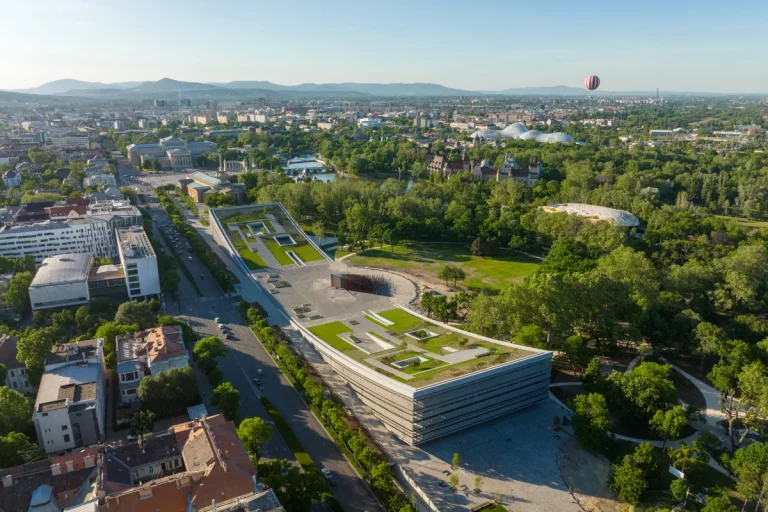
If you walk through Budapest’s Városliget (City Park) today, it is impossible to miss the striking structure rising smoothly from the ground like a massive half-pipe. After a century and a half of wandering, the Museum of Ethnography (Néprajzi Múzeum) finally opened the doors to its custom-built, permanent home in May 2022. Designed by Marcel Ferencz of the Hungarian firm NAPUR Architect, who beat out architectural heavyweights like Zaha Hadid and Rem Koolhaas for the commission, the building acts as a physical and visual gateway between the bustling city and the tranquility of the park. By placing the vast exhibition buildings below ground level, this building achieves the perfect balance between preserving the old scale of City Park and offering a large amount of space for one of the most important cultural collections in Europe. A 150-Year Journey Home The museum’s collection now boasts over 250,000 items from the Carpathian…