
Any tourist asked about their plans for Budapest will definitely tell that they want to visit a “ruin bar.” And there is little doubt that their first step will be directed towards District VII, Erzsébetváros, which goes under another name: the Jewish Quarter.
At night, these few square kilometers become one of the liveliest, chaotic, and dynamic places in all Europe to go to a party. However, during the day, the strobes disappear to unveil a district rich in history. It is a place of elegant Moorish buildings along the streets where you can see walls with bullet holes, and kosher bread shops right next to gourmet coffee roasters.
But to get to know more about Budapest, one needs to peel off the layer of neon. Here begins the history of the Jewish Quarter, from its golden era to its darkest times, and its amazing comeback in modern days.
The Golden Age and the “Jewish Triangle”
During the period between the mid-19th century and the early 20th century, there existed a large and prosperous assimilated community of Jews in Budapest. This was an age marked by immense affluence and intercultural interaction. The business environment thrived and magnificent structures were erected by this community.
This area is characterized by three important synagogues, which are referred to as the Jewish Triangle. They represent three important sects of Judaism as follows:
1. The Dohány Street Synagogue (Neolog)
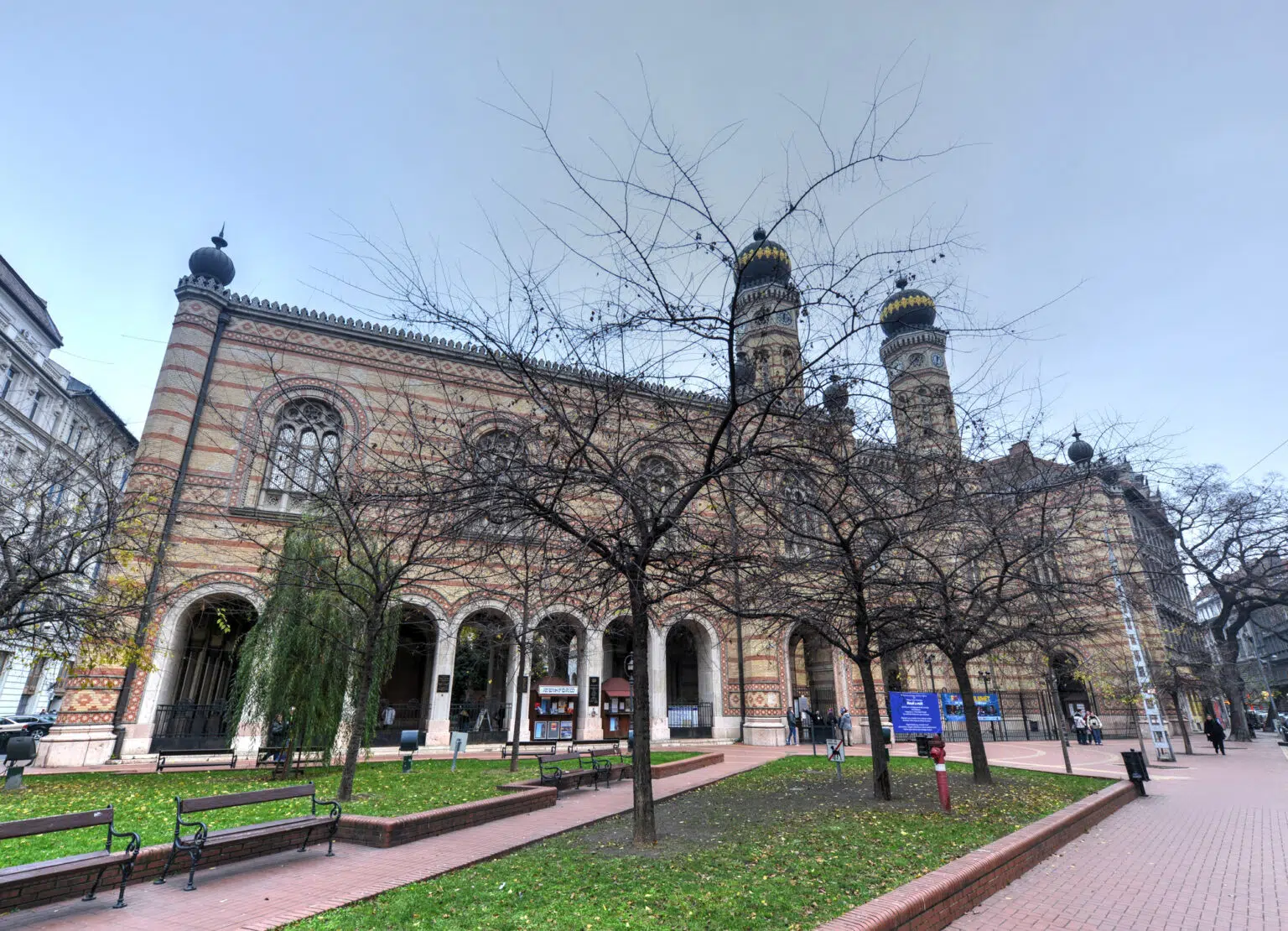
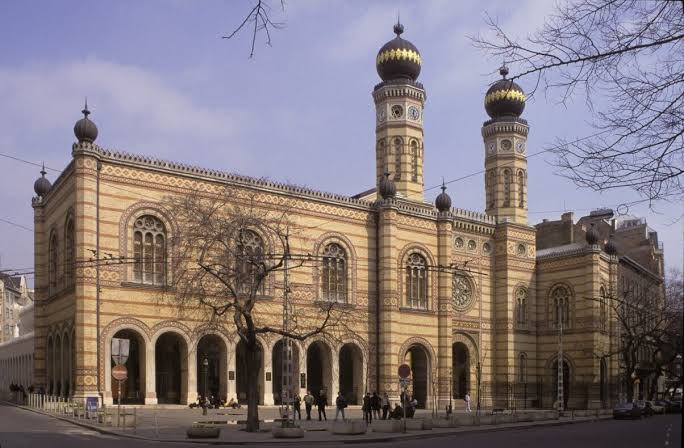
This is the undeniable crown jewel of the district. Built in the 1850s, it is the largest synagogue in Europe (and the second largest in the world). With its stunning twin towers, striped brickwork, and intricate Moorish Revival style, it looks more like a grand palace than a traditional temple.
Behind the synagogue is the Raoul Wallenberg Memorial Park, home to the hauntingly beautiful Tree of Life, a silver weeping willow sculpture where each metal leaf bears the name of a victim of the Holocaust.
2. The Kazinczy Street Synagogue (Orthodox)
Tucked away on a much narrower street, this synagogue is the center of Budapest’s Orthodox Jewish community. Completed right before World War I, it is a brilliant example of late Art Nouveau architecture. Today, the street surrounding it is the best place to find authentic kosher butchers, bakeries, and traditional restaurants.
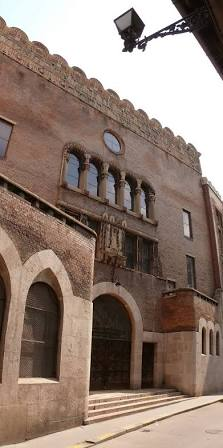
Synagogue, the spiritual center of the city’s Orthodox community.. Source: Wikipedia
3. The Rumbach Street Synagogue (Status Quo Ante)
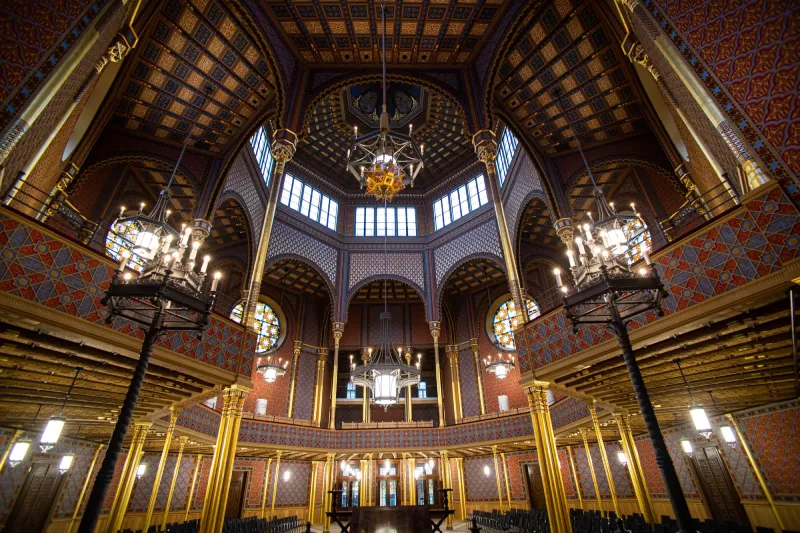
Designed by the famous Viennese architect Otto Wagner, this gorgeous building served the moderate “Status Quo” community. After decades of severe neglect during the Communist era, it was recently meticulously restored to its original, breathtaking gold-and-blue glory.
The Darkest Hours: The Budapest Ghetto
There is no way that you can enter this area without being faced with its sorrowful past. During the last days of the Second World War in 1944, the Nazis made over 70,000 of the Jewish citizens of this city go into a sealed-off ghetto in the seventh district.
Wooden barricades and stone walls went up overnight sealing off the roads. Many succumbed to hunger, disease, and the cold before the liberation of the ghetto by the Soviet troops in January 1945.
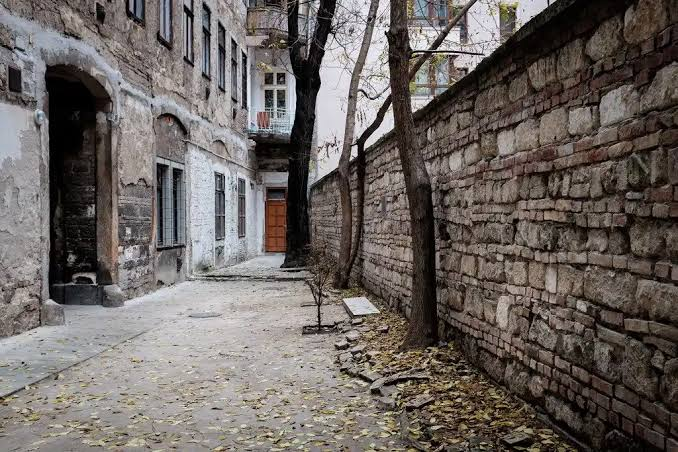
Tip: On Király utca 15, hidden inside a residential courtyard, stands one of the last remaining original sections of the brick Ghetto Wall. It was restored in 2010 and serves as a quiet, powerful memorial.
The Modern Rebirth: Ruin Bars and Courtyards
Following the war and during the era of Communism, District Seven became a deserted place where the magnificent apartment blocks were deteriorating, with their roofs falling and yards becoming cluttered with trash. But things started to change in the early years of the 21st century.
Young residents of Budapest decided to rent an immense dilapidated building, furnish it with mismatching secondhand furniture, paint its walls with unusual paintings, and open an inexpensive bar which they called Szimpla Kert (Simple Garden). Unconsciously, they became the founders of Ruin Bars. Instead of demolishing the decaying historical structures, businessmen took advantage of their condition.
Source: Time Out
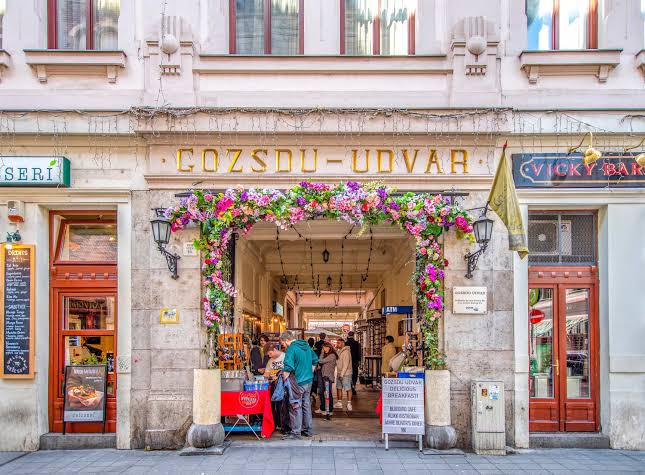
Today, the district is defined by spaces like Gozsdu Udvar, a sprawling series of interconnected courtyards that stretch between Király Street and Dob Street. Originally built in the early 1900s as a commercial center for Jewish merchants, it sat empty for decades. Now, it is completely packed with trendy cafes, craft beer pubs, international restaurants, and weekend artisan markets.
How to Best Experience District VII
- Walk, Don’t Drive: The streets are narrow, one-way, and heavily trafficked. This is a neighborhood meant to be explored entirely on foot.
- Look Up: The ground floors might be covered in street art or neon signs, but if you look up at the second and third stories, you will see gorgeous, original 19th-century stonework and balconies.
- Balance Your Visit: Come during the morning to visit the synagogues and museums when it is quiet and respectful. Then, return in the evening to grab a slice of street-food pizza, sip a local Fröccs (wine spritzer) in a ruin courtyard, and feel the pulse of a neighborhood that refused to be forgotten.
Comments are closed.