
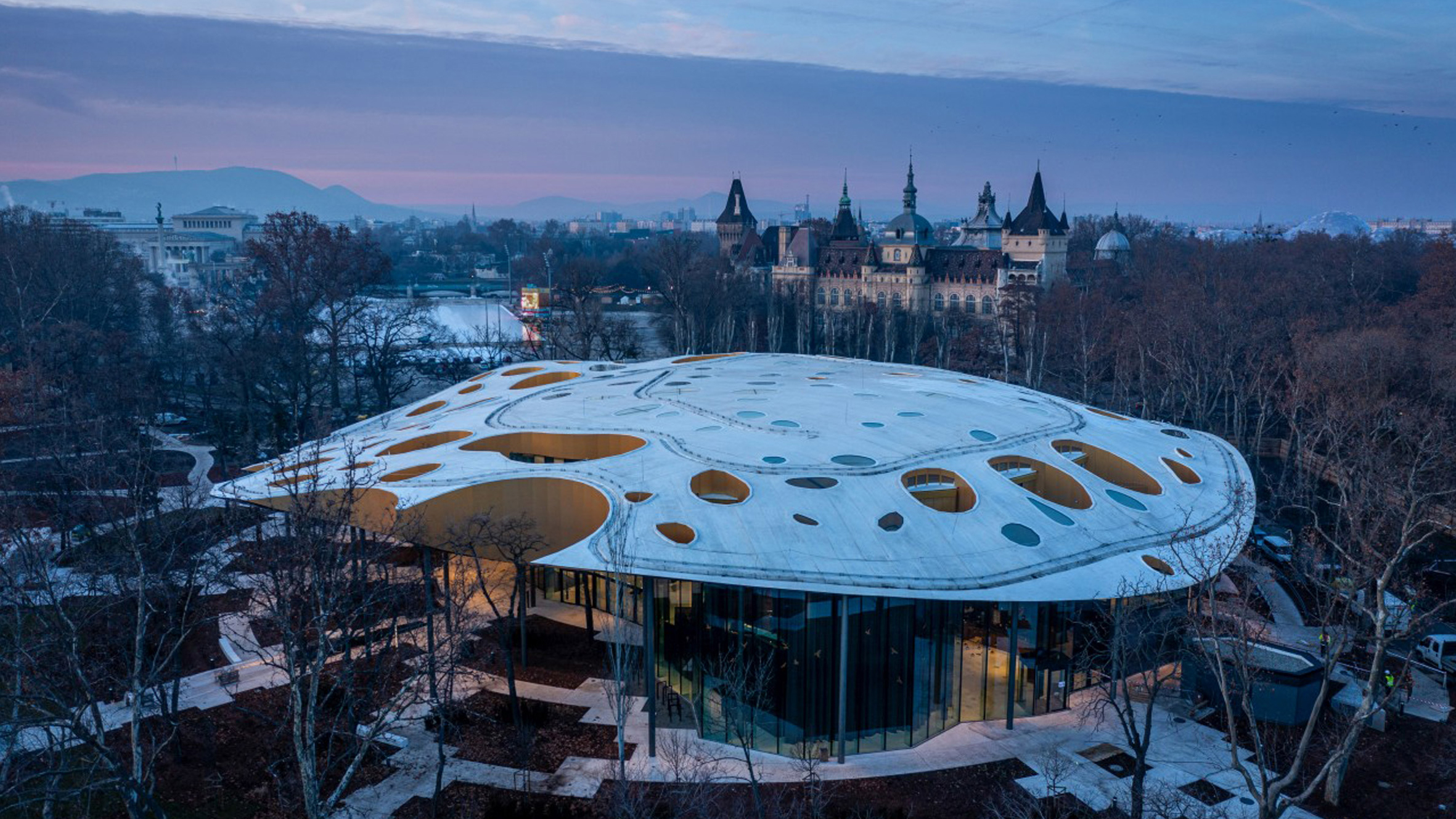
Imagine wandering through the dense, leafy trails of Budapest’s City Park (Városliget) and suddenly stumbling upon what looks like a giant, golden mushroom floating among the trees.
This is the House of Music Hungary (Magyar Zene Háza).
Since opening its doors in early 2022, this spectacular, undulating structure has completely redefined the city’s architectural landscape. It doesn’t just house music, the building itself is designed to feel like a visual symphony, thanks to his beautiful structure.
Here is everything you need to know about how this beautiful structure was conceptualized, engineered, and what awaits you inside.
The Vision and History
For decades, the plot of land where the House of Music now sits was a dead zone, occupied by a cluster of abandoned, dilapidated Hungexpo office buildings.
In 2014, as part of the massive Liget Budapest Project (the same initiative that built the nearby Museum of Ethnography), the city launched an anonymous international competition to design a space dedicated to the history and experience of music. Out of 170 global submissions, visionary Japanese architect Sou Fujimoto won the jury over.
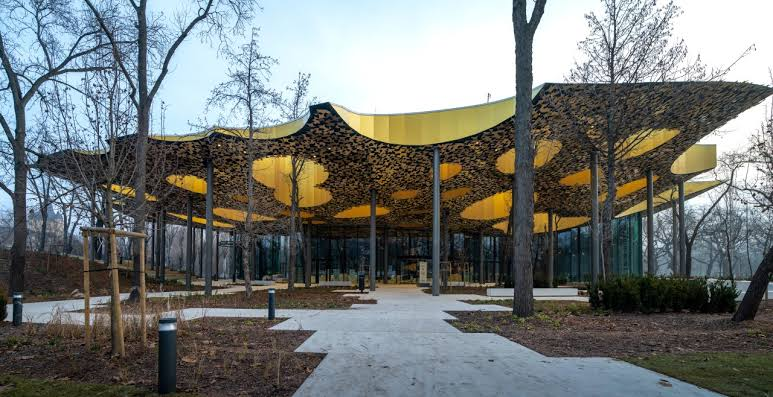
His concept was profoundly simple: What if the boundaries between the natural forest and the built environment completely disappeared? He wanted visitors to feel as though they were walking under a protective canopy of leaves, where music and nature could interact seamlessly.
How It Was Constructed
Constructing a structure that is composed of absolutely no straight lines or right angles would call for complete perfection in engineering. What appears before your eyes is an extremely complicated arrangement of steel, glass, and acoustics.
The Undulating Roof and “Lightwells”
The building’s outstanding feature is its huge roof design that features holes similar to craters. While some of these holes are used as lightwells to let the sunlight reach even the underground level of the building, others are directly connected to the existing trees in the park so that the ancient trunks can literally penetrate the building’s structure.
The 30,000 Golden Leaves
The eye-catching golden-yellow color underneath the canopy serves not only decorative purposes but also practical ones. In fact, the ceiling is covered with 30,000 geometrical metal leaves. While beautiful, the main purpose of the leaves is that of baffling and absorbing sound waves.
The Seamless Glass Walls
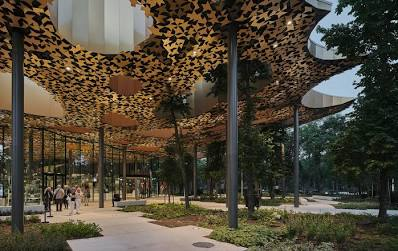
To blur the line between the indoors and outdoors, Fujimoto wrapped the entire ground floor in 94 custom-manufactured, thermal glass panels.
- Standing up to 12 meters (nearly 40 feet) tall, they are some of the largest horizontal glass panels in Europe.
- Instead of being completely flat, they are arranged in a subtle zig-zag formation. The zig-zag shape reflects sound waves upward into the golden ceiling rather than bouncing them back into the audience.
The Building by the Numbers:
| Feature | Design Detail |
| Shape | Zero right angles in the entire core structure |
| Glass | 94 panels, reducing solar heat gain by 37% |
| Sustainability | Zero fossil fuels; heated and cooled by 120 geothermal probes |
| Acoustics | Custom zig-zag glass walls prevent audio distortion |
A Journey Inside: The Three Movements
Fujimoto deliberately designed the building to mirror a musical score, dividing it into three distinct “movements” or levels.
1. The Roots (Underground)
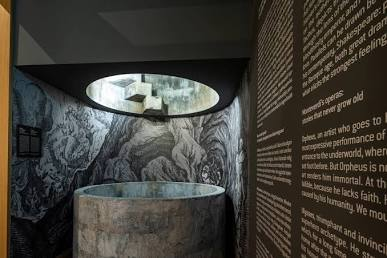
Because the ground floor is entirely transparent, all the heavy lifting happens in the massive basement level. This is where you will find the permanent exhibition: Sound Dimensions – Musical Journeys in Space and Time. It is a highly interactive labyrinth that walks you through the 2,000-year history of European music, right up to modern Hungarian pop.
zenehaza.hu
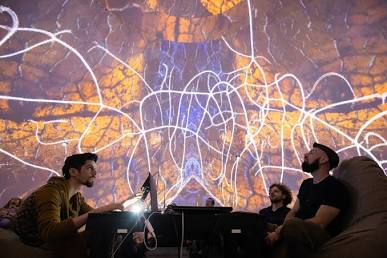
Also hidden down here is the Sound Dome (Hangdóm). Imagine stepping into a giant, plush hemisphere where 31 separate loudspeakers surround you. Up to 60 people can sit in the dome and experience a completely immersive 360-degree audio and visual projection that is really enjoyable, since the quality of the sound is insane.
zenehaza.hu
2. The Trunk (Ground Floor)
The park-level floor is the active heart of the building. It contains a 320-seat glass-walled auditorium and a smaller venue for lectures. Because the walls are completely transparent, you can sit inside a classical or jazz concert while watching snow fall or leaves blow through the park just inches away.
3. The Canopy (Top Floor)
Tucked up inside the undulating roof structure itself is the educational tier. This space houses a multimedia library, archives, and classrooms dedicated to musical education. It is a quiet, elevated space that truly feels like a treehouse.
The Outdoor Musical Playground
Don’t leave without walking behind the building. The architects designed an interactive musical playground where families can walk across musical paving stones, play giant chimes, and experiment with physical sound waves in the open air.
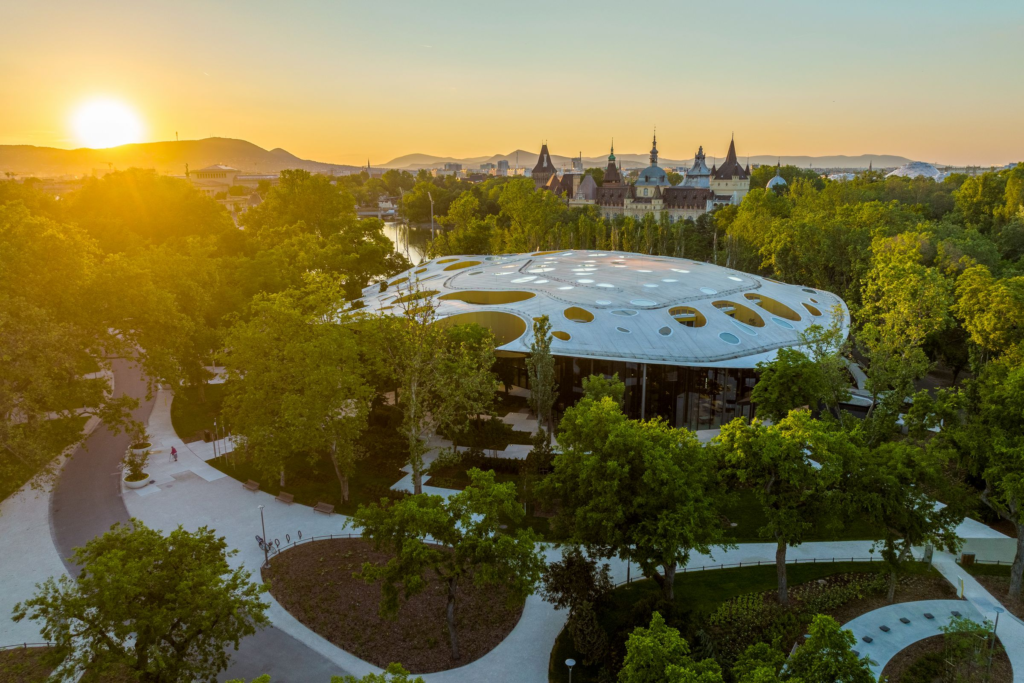
There are a lot of places to stay, and there are places to actually sit and watch some projections of films, or other type of content, it’s a really good place, and even if you don’t want to pay any money to do the paid activities, you are still granted inside the structure for free, where you can enjoy bookshops, cafe’s….
Comments are closed.