
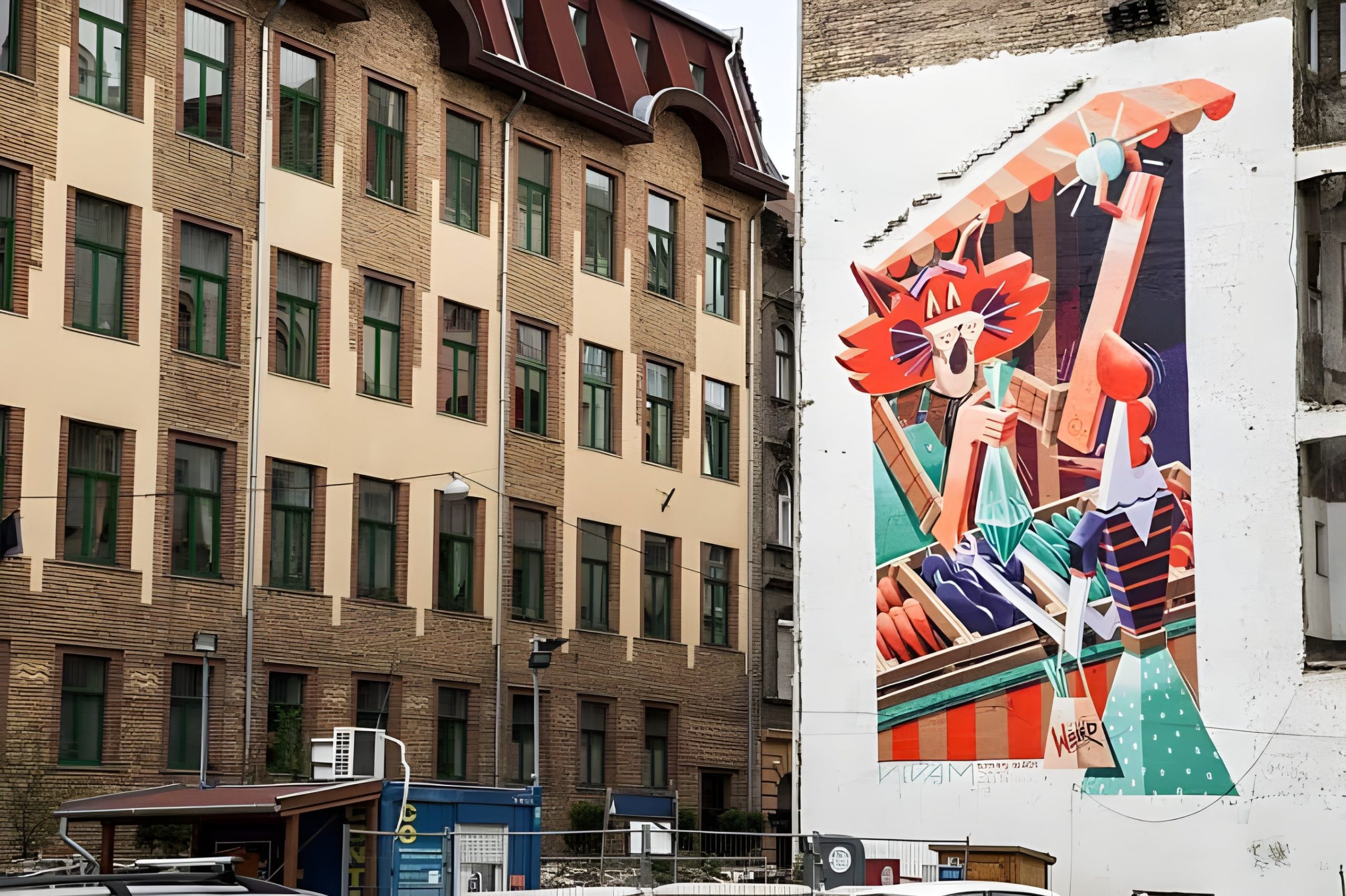
Whenever someone mentions Budapest, the first thing that pops up in their mind is the majestic neo-Gothic Parliament building, the panoramic views from Fisherman’s Bastion, or perhaps the soothing experience at the thermal baths. However, if you look closely, especially at the gigantic, stark brick walls known as tűzfalak in District VII, you will see a totally new and very colorful world.
Budapest has become one of the most intriguing capital cities in Europe in terms of urban art. This is not some form of nightly graffiti; it is a large-scale process that combines rich Hungarian tradition and culture with top-notch contemporary art.
From Graffiti to Grand Firewalls
Just a few decades back, District VII was marked by its atmospheric, but highly neglected and bullet-ridden buildings that remained after the dark times of the 20th century. While the legendary Ruin Bars started decorating these neglected premises with vibrant nightlife, an equally revolutionary process was going on in terms of the facade.
Instead of trying to fight against the illegal graffiti with grey paint, the city had an idea that deserves praise: the authorities have given all those walls to the artists.
There were two collectives that revolutionized the city landscape:
- Neopaint Works: A group of Hungarian street artists and monumental painters whose artworks were based mostly on historical subjects, local legends, and nostalgic memories of the urban environment.
- Színes Város (Colorful City): An organization that organizes annually an enormous festival called Színes Város Festival and invites both international and local top artists to make huge murals based on different themes chosen every year – be it wine and gastronomy or literature.
Thus, due to the legitimate initiative of the authorities, the vast grey walls of neglected residential blocks turned into giant canvases.
Must-See Murals and the Stories Behind Them
If you’re ready to lace up your sneakers and explore, here are the best graffiti you need to track down in the Jewish Quarter.
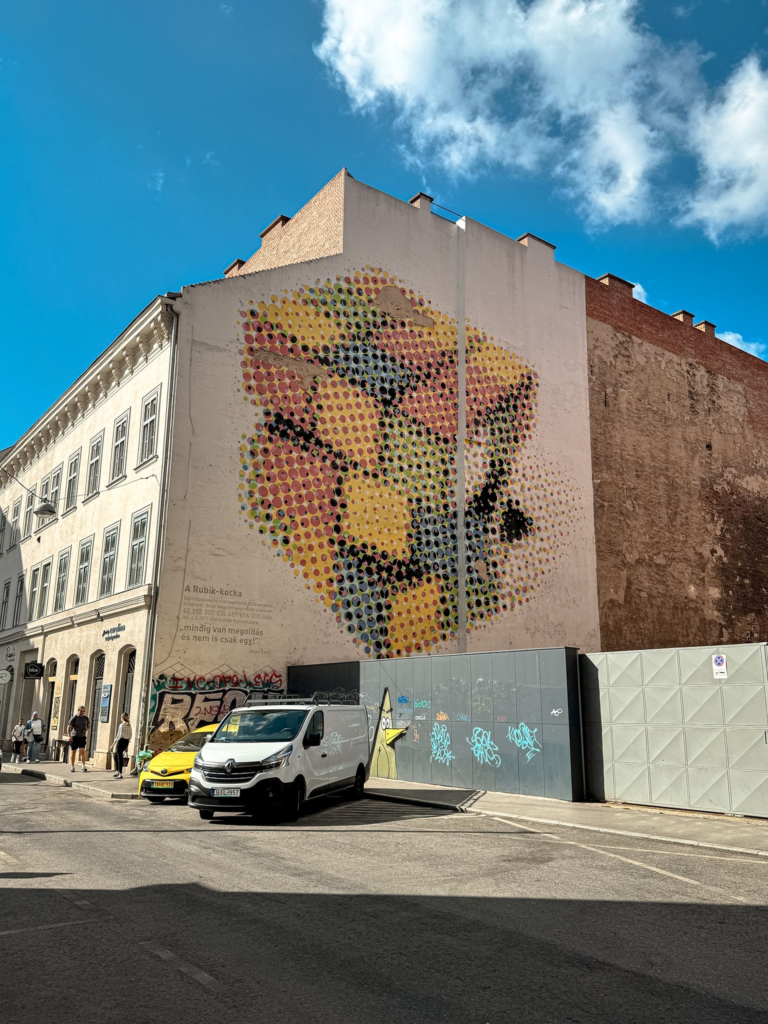
1. The Rubik’s Cube
- Location: 5 Rumbach Sebestyén Street
- Created by: Neopaint Works
You can’t talk about Hungarian genius without mentioning Ernő Rubik, who invented the iconic 3D puzzle in 1974. Painted in 2015 to celebrate both the cube’s 40th anniversary and its inventor’s 70th birthday, this 250-square-meter mural is an optical masterpiece.
Source: todamo/Getty Images
What to look for: If you stand directly underneath it, the mural looks like a chaotic cluster of thousands of tiny, colorful painted circles. But step back across the street or pull out your phone camera, and the optical illusion snaps into place, revealing a perfectly formed 3D Rubik’s Cube. On the corner, you’ll spot the number 43,252,003,274,489,856,000—the exact number of possible scrambles.
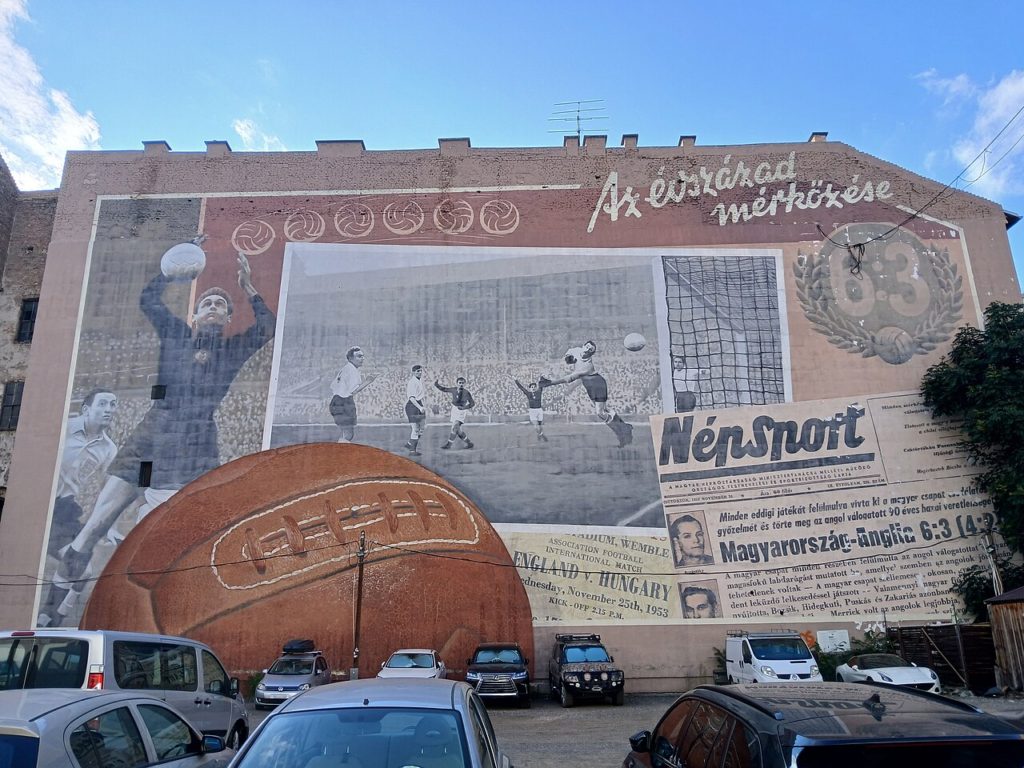
2. The Match of the Century (6:3)
- Location: 10 Rumbach Sebestyén Street
- Created by: Neopaint Works
Right across the street from the Rubik’s Cube sits a massive 1,000-square-meter tribute to a defining moment in Hungarian sports history. In 1953, the legendary Hungarian “Golden Team” (led by Ferenc Puskás) defeated England 6–3 at Wembley Stadium. England had never lost a home game to a non-British team until that day. The mural captures the raw energy of the match and even replicates a vintage sports newspaper reporting the historic upset.
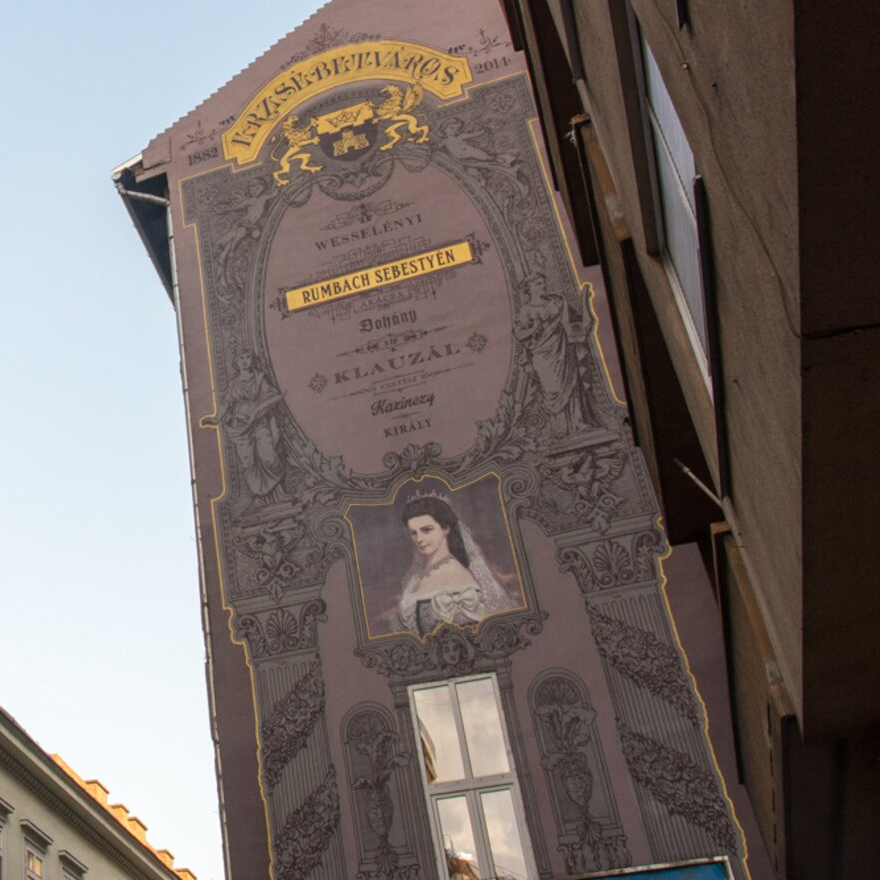
3. Queen Sisi
- Location: 10 Rumbach Sebestyén Street (on the reverse side)
- Created by: Neopaint Works
On the back of the same building complex, you’ll find a beautifully delicate portrait of Empress Elisabeth of Austria, affectionately known to Hungarians as Sisi. She was deeply beloved by the Hungarian people for her role in the 1867 Austro-Hungarian Compromise. This mural is incredibly fitting: the official name of District VII is Erzsébetváros (Elizabeth Town), named explicitly in her honor. The piece feels like a vintage 19th-century postcard scaled up to a massive urban scale.
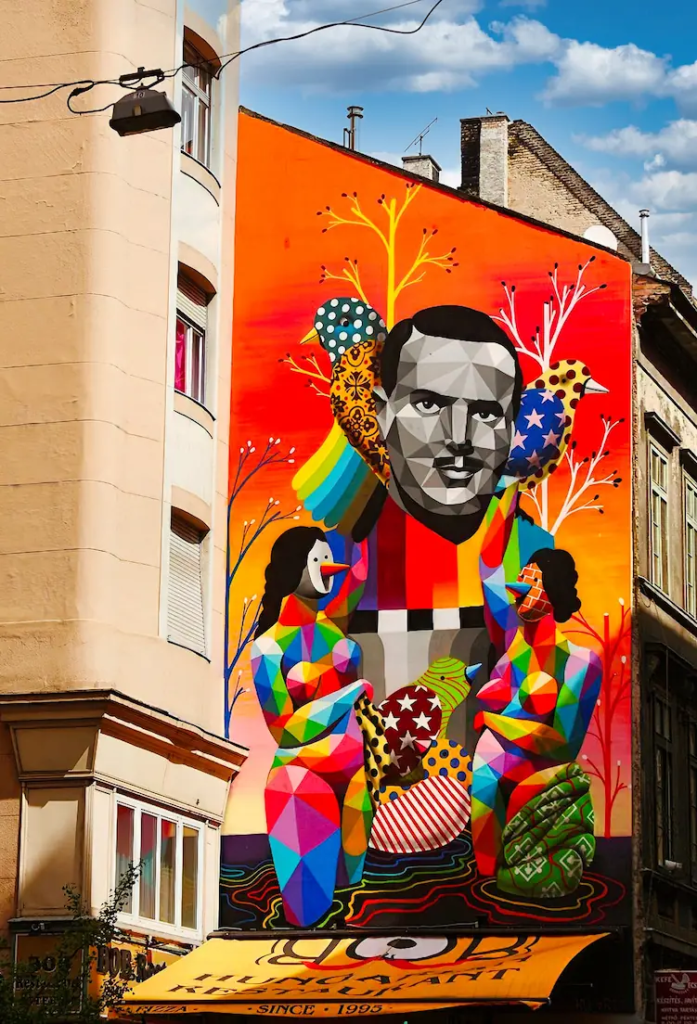
4. The Angel of Budapest (Ángel Sanz Briz)
- Location: 4 Dob Street
- Created by: Okuda San Miguel
If you love vibrant, geometric, and surrealist pop art, this one will stop you in your tracks. Painted by world-renowned Spanish street artist Okuda San Miguel, this exploding kaleidoscope of color honors Ángel Sanz Briz. He was a Spanish diplomat who risked everything during World War II to save over 5,000 Hungarian Jews from deportation by issuing them fake Spanish passports.
Ruin Bars: Where Street Art Meets Nightlife
You can’t fully separate Budapest’s street art culture from its nightlife culture. They evolved together. If the outer firewalls represent the polished, curated, and monumental side of the scene, the insides of the neighborhood’s famous ruin bars are where the raw, organic, and underground essence lives.
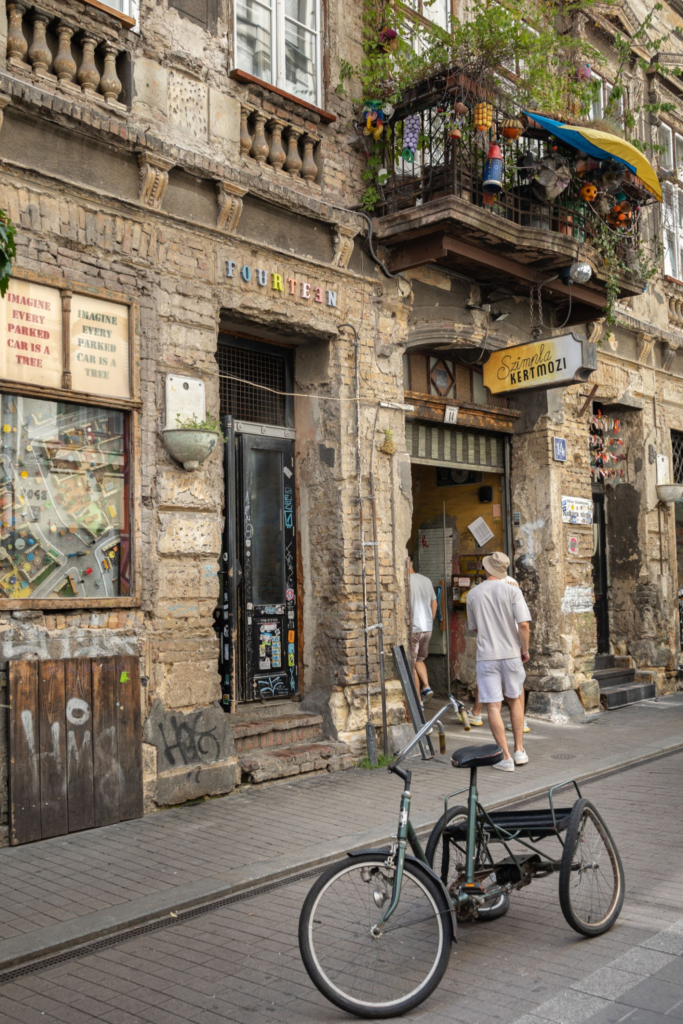
The absolute epicenter of this is Szimpla Kert.
Getty Images
When one enters Szimpla Kert, one has entered into an art installation which is alive and thriving. The whole place, including ceilings, old computer monitors, building columns, and abandoned Trabant cars from the past, is covered in graffiti, stickers, posters, and sculptures created by local and international artists while enjoying a beer.
Tips for the Ultimate Art Walk
- Look Up, Look Behind: Many of the best murals are tucked away inside open parking lots or visible only when you look back after crossing an intersection.
- Start at Deák Ferenc Tér: Walk down Király Street and slice through Rumbach Sebestyén, Kazinczy, and Akácfa streets. This forms a natural loop covering 80% of the city’s iconic pieces.
- Spot the Stickers: Keep an eye out for smaller sticker art and paste-ups on lampposts and mailboxes. You might even spot a sneaky mosaic tile left behind by the legendary French space-invader artist, Invader.
Comments are closed.