

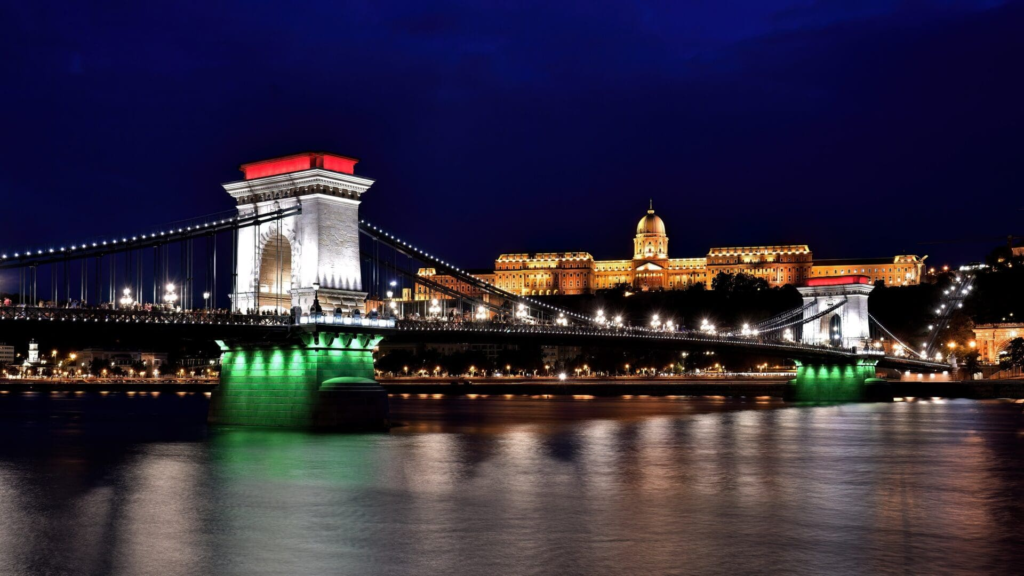
Walking along the Danube River, you can’t help but notice the most striking part of Budapest’s skyline: the Széchenyi Chain Bridge. With its amazing feat of engineering and two sturdy ends in Buda and Pest, it’s more than just a bridge—it represents Hungarian pride and unity. Now, underneath its fancy look and hefty chains is a popular tale locals adore. This story is about a nearly flawless design, a big embarrassment, and someone taking a tragic jump off the bridge into the icy water. People love sharing this intriguing mix of despair and mystery that sits alongside its glorious architecture.
Why the Bridge Was Built
The Chain Bridge’s size makes sense once you know about Buda and Pest before its construction. From 1849 on, these two cities were connected by the new bridge. Before that, during summertime, folks could use a floatable bridge to get across the Danube. Yet in wintertime, when chunks of ice could render crossing risky and ferry services stopped, people would be stuck on either side.This frustrating situation moved Count István Széchenyi to action. He was a major historical figure in Hungary’s reform movements. One sad December in 1820, Széchenyi learned that his dad had died. Trying desperately to reach the funeral, he faced impossible conditions at the river. Terrible winter weather kept him stranded for an entire week. This heartbreaking experience pushed him to pledge that he’d make and fund a big bridge. His goal? To prevent separations due to icy river conditions.Széchenyi got William Tierney Clark, an English engineer, to draw up plans. Then Adam Clark, a Scotsman, oversaw the build. Once completed, the 202-meter central span put it among the largest suspension bridges in the world, a true cutting-edge of modern civil engineering.

The Legend of the Tongueless Lions
In 1852, exactly three years post-opening, János Marschalkó’s four majestic stone lions got put in place on the Chain Bridge. These guys were built to be fierce, muscular, and super detailed—they finished off the bridge’s stunning look perfectly. Now, here’s where things get interesting. Legend says, at the unveiling, there was this moment where everyone’s eyes were on the massive stone lions. Suddenly, Jakab Frick, some shoemaker’s apprentice, burst into laughter. He then hollers at the gathered folks, “What’s up with these lions? They’re totally missing tongues!” So, the group took a good hard look and noticed he was right. Inside each lion’s open mouth, there wasn’t a trace of any tongue. The embarrassed sculptor couldn’t handle being laughed at across the city. Feeling humiliated, Marschalkó is said to have run right to the edge of the bridge and jumped into the Danube. This tragic event makes him the very first recorded person to leap from what would later become famously known as “Suicide Bridge.”
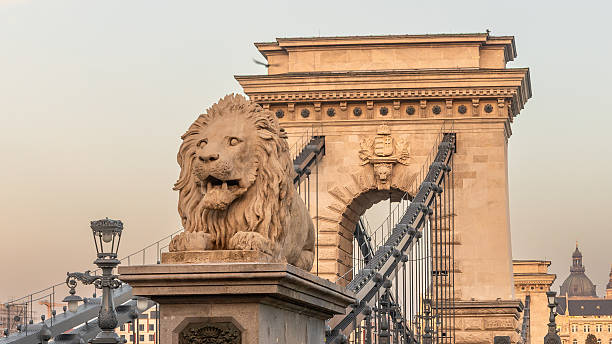
Fact-Checking the Lore: Do the Lions Have Tongues?
Is it really true? Nope, not at all. First off, both the engineers and the sculptor were still very much alive – they didn’t kill themselves. In fact, János Marschalkó went on to lead a long and prosperous life. He created more amazing sculptures around Budapest that can be seen to this day. Now, about those lions – they do have tongues! It’s pretty straightforward. When Marschalkó made the lions, he positioned them lying down with their mouths wide open. If you take a look inside any lion’s mouth when it’s relaxed, its tongue usually sits way at the bottom. Given that the lions are up high on tall plinths, people walking by simply can’t see that far inside. This myth got so annoying in 19th-century Budapest that Marschalkó decided to put an end to the jokes. Legend says he wagered a ton of money, took his skeptics to see a real lion at the circus, and showed them its tongue wasn’t visible when looking up at it. He won, kept his cash, and then generously gave it all to charity. He was even quoted in local papers firing back at the critics, saying: “I wish your wife’s tongue was as quiet as my lions’!”
The bridge today
The lion legend is far from the only thrilling part of the Chain Bridge’s story. This bridge has been a key target during major conflicts and barely escaped damage more than once. In 1848, it narrowly dodged the Austrian forces’ attacks, but had less luck in January 1945 when Nazis retreated during World War II and bombed all the Danube-crossing bridges in Budapest. The Chain Bridge was utterly destroyed, save for its two beautiful stone towers left amongst the wreckage.Showing true resilience, it was faithfully reconstructed to look just like the original and reopened in 1949—centennial of its first unveiling. Fast forward a bit, and the bridge got another major upgrade in a long-term renovation focusing on both its structure and appearance. Each colossal lion, comparable in weight to a full-size city bus, needed extra care. The statues were disassembled, cleaned using chemicals, fixed, and put back. Now the lions are in top shape, keeping their vigilant pose over the Danube, still perfect down to their hidden tongues!
Comments are closed.